
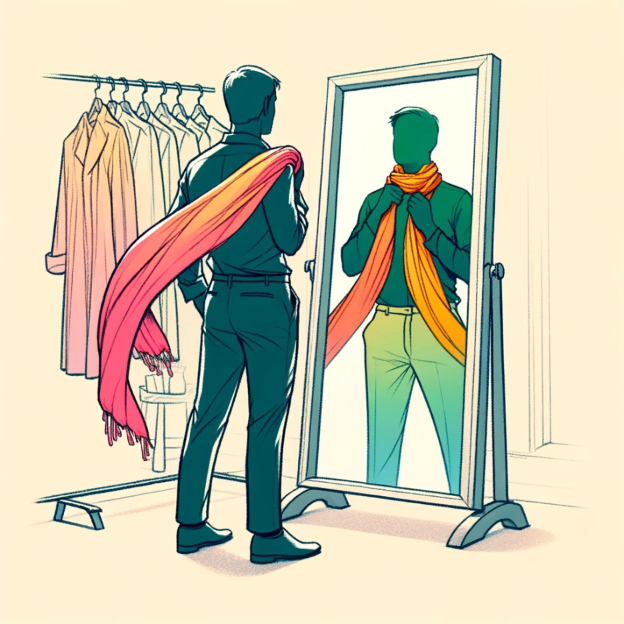
The Thing You Keep Putting Back
Most of us have something we keep almost choosing. It sits in the wardrobe, or at the bottom of a drawer, or gets picked up and put down again in the morning rush. Too bright. Too much. Not really me. We tell ourselves we will wear it another time — someday when we feel more confident, or the occasion is right, or we care a little less what anyone thinks. That someday has a habit of not arriving.
What is it about a small, harmless choice that can feel so loaded?

The Habit of Disappearing Into Ourselves
The clothes we put on every morning are rarely neutral. They are, for most of us, a quiet negotiation — between how we feel and how we want to be seen, between who we are and who we think we are supposed to be. Over time, those negotiations solidify into habits. We reach for the same colours, the same shapes, the same reliable invisibility. Not because we love them particularly, but because they feel safe.
Psychologists call this behavioural consistency — our tendency to act in ways that confirm our existing self-concept. We dress like ourselves because it feels coherent. The problem is that our self-concept is not always the most generous version of who we are. Sometimes the story we are dressing for is an old one — written in a classroom, or a difficult relationship, or a passing comment we absorbed years ago and never quite put down.

What a Small Departure Actually Does
Here is what is interesting: the research suggests the relationship between what we wear and how we feel runs in both directions. We do not just dress to match our mood — what we wear can shift it.
A well-known 2012 study by Hajo Adam and Adam Galinsky, published in the Journal of Experimental Social Psychology, introduced the term “enclothed cognition” to describe the systematic influence clothing has on the psychological state of the wearer. Their finding was specific and striking: it is not just the garment itself that matters, but the meaning we assign to it. The physical experience of wearing something we associate with a particular quality — confidence, creativity, boldness — can quietly activate those very qualities in us. The full study is available here.
This does not mean dressing up solves anything serious. But it does suggest that small, conscious choices about how we present ourselves are not as trivial as we tend to dismiss them.

The Deeper Question Underneath the Wardrobe
Clothing is rarely just clothing. For many people — particularly women, but not only — decisions about appearance carry a freight of old messages. Be less. Take up less space. Don’t draw attention. Don’t try too hard. These messages arrive early and embed quietly, and they shape not just what we wear but what we allow ourselves to want.
Karen Pine, a professor of psychology at the University of Hertfordshire and author of Mind What You Wear, has written extensively about the emotional dimension of clothing choices. Her research found that people who were asked to wear a Superman t-shirt subsequently rated themselves as more likeable and superior — a finding that points to something most of us know intuitively but rarely examine: that what we put on our bodies is also, in some way, a statement we make to ourselves.
The choice to try something we would normally talk ourselves out of is, underneath the surface, a small act of permission. Permission to be a little more visible. A little more curious about who we might be outside the usual script.

Why “Just Try It” Is Harder Than It Sounds
There is a reason novelty — even welcome novelty — produces a flicker of anxiety before it produces anything else. Our brains are wired to flag departures from the expected as potential threats, however minor. That slight self-consciousness when you wear something unfamiliar is not a signal that you have made a mistake. It is simply your nervous system noticing a change.
What is worth paying attention to is what comes after that initial flutter. For many people, the self-consciousness fades. Something else arrives — a quiet satisfaction, a sense of being slightly more present in their own skin, or simply the realisation that nothing terrible happened. That small discovery, repeated over time, is how old stories begin to loosen their hold.

A Note on This
At My Fyrst, the premise is simple: emotions are signals, not verdicts. The way we move through a day — including the choices we make about how we show up in it — generates information worth noticing. Not to judge or analyse, but to become a little more acquainted with ourselves.
There is a framework of nine essential emotions at the heart of the practice, drawn from ancient Indian classical tradition. What a small act of self-expression stirs might sit close to Vīra — a quiet courage, a sense of quiet capability. Or it might be closer to Adbhuta, a flicker of curiosity about what else might be possible. Both are worth sitting with. Neither needs to be forced.
Before You Dismiss It
The next time you pick something up and put it back — pause for just a second. Not to talk yourself into wearing it. Just to notice what the hesitation is made of. Where did that voice come from? Whose opinion is it, really?
You do not have to answer the question fully. You do not have to wear the thing. But the noticing itself — that small moment of awareness before the automatic choice takes over — is where something interesting tends to begin.

My Fyrst is a personal practice, not therapy or clinical support. If you are going through a difficult time, please speak with a qualified mental health professional.