
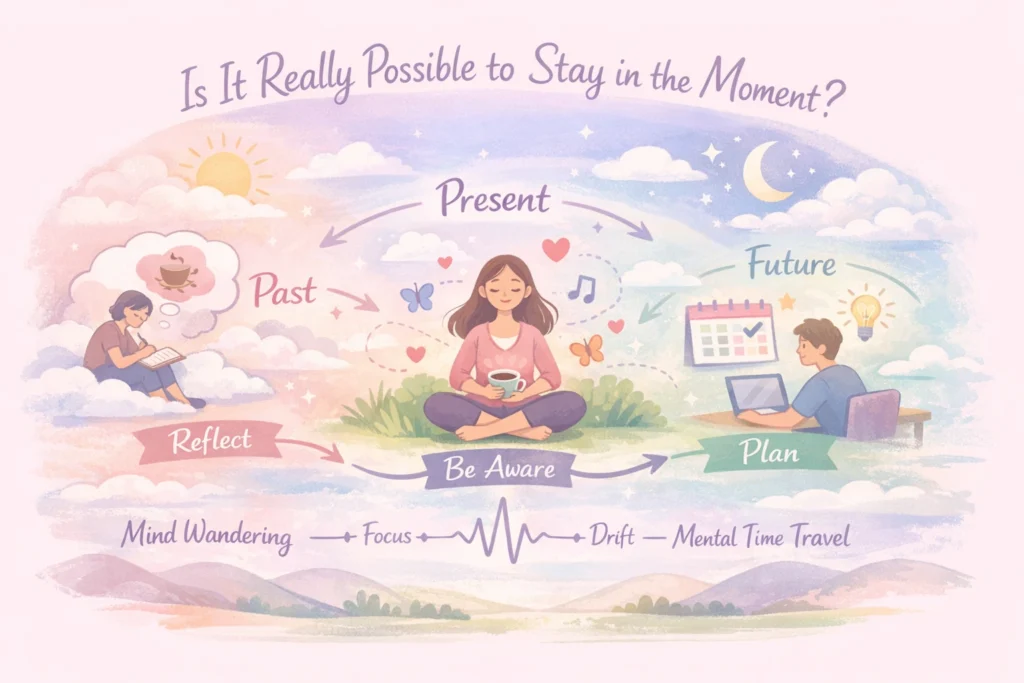
Is It Really Possible to Stay in the Moment? Why Presence Isn’t About Staying — It’s About Returning
While the idea of “living in the moment” is often praised in mindfulness and wellness spaces, our brains are not built to stay there constantly. In fact, one of the most powerful abilities humans have is the capacity to move mentally through time — reflecting on the past and imagining the future.
This ability helps us learn, plan, and grow.
The Brain’s Natural Tendency to Wander
Your brain has a built-in system called the Default Mode Network (DMN). This network becomes active whenever you are not focused on a specific task.
It is responsible for many familiar mental activities:
- daydreaming
- replaying conversations
- imagining future scenarios
- processing social interactions
Studies suggest that our minds wander almost half of the time. This wandering isn’t a flaw — it is part of the brain’s natural operating system.
Trying to suppress it completely would likely create mental fatigue rather than calm.
Presence Is About Returning, Not Staying
A helpful way to think about presence is like exercising a muscle.
Imagine you are at a dinner with friends and suddenly realize your mind has drifted to work, tomorrow’s schedule, or something that happened earlier in the day.
That moment of realization is the actual practice.
The goal is not to eliminate drifting.
The goal is to notice it sooner and gently return to what is happening right now.
Presence is less about perfection and more about awareness.
When Leaving the Moment Is Useful
There are many situations where stepping out of the present moment is not only normal, but necessary.
Planning
Thinking about the future helps us anticipate challenges and prepare for them.
Learning
Reflecting on the past allows us to understand mistakes and make better decisions.
Creativity
Some of the best ideas appear during mind-wandering moments, when the brain is making unexpected connections.
Without this mental flexibility, progress and innovation would be far more difficult.
Finding the Right Balance
Instead of trying to remain present all the time, it may be more helpful to think in terms of balance.
Presence
Useful during meaningful conversations, when eating, when feeling stressed, or when learning something new.
Autopilot
Helpful during routine activities like walking, cleaning, or commuting, allowing the brain to rest.
Reflection
Intentional time to think about the past or plan the future, such as journaling or reviewing personal goals.
Each state has its purpose.
The Pulse of Awareness
Being present is not meant to be a constant state.
It is more like a rhythm.
You pay attention.
Your mind drifts.
You notice.
You return.
Over time, the practice becomes simply recognizing the drift a little sooner.
The real skill is not staying perfectly in the moment — it is learning how to come back to it when you need to.