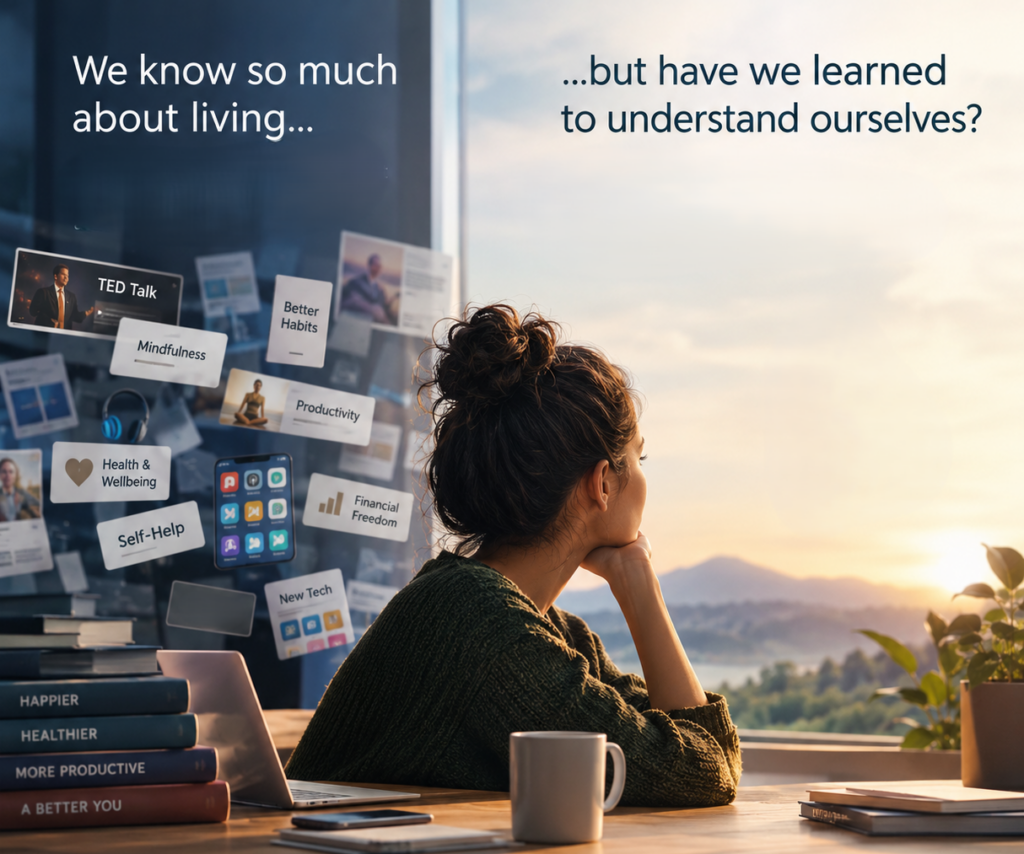
We Know So Much About Living. But Have We Learned to Understand Ourselves?
In a world full of advice on how to live better, perhaps the first step is to pause and understand the life we are already living.
We live in a world that rarely asks us to slow down. There is work to finish, technology to keep up with, rising living costs to navigate, relationships to maintain, and expectations to meet. Every day brings new information, new challenges, and new reasons to keep moving. Somewhere along the way, we try to find ways to live better.
We listen to TED Talks, follow experts, read books, and explore apps that promise to help us become happier, healthier, more productive, or more mindful. We save articles, collect advice, and feel inspired by the possibilities.
Yet, after all that listening and learning, how often do we return to ourselves?
How often do we stop to notice how tired we really are? Not just physically, but emotionally. How often do we recognise what has been weighing on us, what has been occupying our thoughts, or why certain situations affect us more than others? We may know a great deal about living well without necessarily understanding what is happening within us.
When the Search for Answers Becomes Another Source of Noise
Seeking knowledge is not the problem. Learning can open our minds, challenge our assumptions, and introduce us to possibilities we had never considered. The difficulty begins when the search for answers becomes so constant that we have little time to make sense of what we have already learned.
One expert tells us to think differently. Another encourages us to change our habits. We hear about resilience, gratitude, productivity, mindfulness, and happiness. Each idea may have value. But we are not all living the same life, carrying the same experiences, or responding to the world in the same way. What works for one person may not feel right for another. And when we are already overwhelmed, more advice can become one more thing to process.
There is another subtle consequence. When we constantly hear about the struggles people face, we may begin to see the world primarily through its difficulties. We recognise that many people are tired, anxious, uncertain, or struggling to keep up. That recognition can remind us that we are not alone. But it can also leave us wondering how to navigate our own experiences within a world that already feels overwhelming. Perhaps what we need is not always another answer.
Perhaps we need a little space to understand our own questions.
What Are Our Emotions Trying to Tell Us?
Our emotions are part of how we experience the world. They influence how we interpret situations, relate to others, make decisions, and respond to what happens around us. Yet, how often do we stop to understand what we are feeling before trying to change it, dismiss it, or move on? We might call ourselves stressed without knowing whether we are feeling overwhelmed, uncertain, disappointed, or frustrated. We might feel irritated by a small incident without recognising that we are already tired or that something about the situation has affected us more deeply.
Psychologist and neuroscientist Lisa Feldman Barrett explores these questions in her TED Talk, You Aren’t at the Mercy of Your Emotions — Your Brain Creates Them. Her work challenges the idea that emotions are simply fixed reactions that happen to us. It explores how the brain makes meaning from bodily signals, past experiences, and the context in which we find ourselves. This does not mean we can choose every emotion we experience. But it invites us to look more closely at how we make sense of our experiences.
Perhaps the first step is not to control an emotion or immediately find a solution. Perhaps it is to notice what we are feeling, consider what might be contributing to it, and remain curious about what we discover. Knowing the word stress is one thing. Recognising how uncertainty, exhaustion, disappointment, or competing expectations might be affecting us is another.
That is where personal reflection begins: not with an immediate answer, but with a willingness to pay attention to ourselves.
The Difference Between Knowing and Understanding
We can learn about emotions without recognising how they show up in our own lives.
We can understand the importance of patience and still find ourselves reacting sharply when we feel pressured. We can know that rest matters and still ignore our tiredness. We can value our relationships and yet struggle to understand why certain conversations leave us unsettled.
Imagine someone responds to you impatiently in the morning, and then someone else does the same later in the day. By the afternoon it feels as though nothing is going your way, and when the next person asks you a simple question, you snap. Often, without noticing, we hand on what we have been given. Now imagine pausing, even briefly and even afterwards, to ask: why was I so sharp? We are not saying you must stop and reflect every time. But a quiet look back gives you a chance to see yourself, and that is where understanding begins.
Knowledge gives us a starting point. Personal reflection helps us connect that knowledge to our experiences. Over time, we may begin to notice recurring patterns.
Perhaps uncertainty often leaves us feeling restless. Perhaps we become irritable when we have taken on too much. Perhaps particular situations bring up feelings we have experienced many times before. These observations do not necessarily provide definitive explanations. But they can offer clues about what affects us and how we tend to respond. With greater awareness, we may find more room to consider our choices. Instead of reacting immediately, we might pause. Instead of dismissing a feeling, we might explore it. Instead of repeating a familiar response without noticing it, we might begin to recognise the pattern. This is not about getting every response right. It is about becoming more familiar with ourselves.
Why the First Step Matters
When we want to change something in our lives, we often begin by looking for a solution. We make plans, set goals, download apps, or promise ourselves that tomorrow will be different. But what if the first step is not to change anything?
What if it is simply to notice?
Notice how we feel after a difficult conversation. Notice what happens within us when plans change unexpectedly. Notice the difference between how we feel when we are rested and how we feel when we have been pushing ourselves for too long. A single moment of awareness may not change much. One reflection may not reveal a pattern. But repeated moments of noticing can give us a more personal understanding of our experiences. This is where patience and consistency matter.
We cannot expect a deeper understanding of ourselves to emerge from a single exercise or a moment of inspiration. Like any foundation, it takes time to build. We need to return to the practice, remain open to what we notice, and allow our understanding to develop. The goal is not to become someone who never feels overwhelmed, frustrated, or uncertain. It is to become someone who is a little more aware of those experiences and better able to consider how to respond.
A Small Step Towards Understanding Yourself
A day like that doesn’t come with a warning, and neither does the moment to reflect on it.
MyFyrst offers a simple, guided practice that brings together activities, emotional awareness, reflection, and the observation of patterns over time. Rather than adding another stream of information to your day, it invites you to step away from the noise for a few moments. An activity offers an opportunity to pause. You notice your emotional response and choose a colour that feels closest to it. You can reflect on what might have contributed to that feeling and keep a record of your observations.
Over time, those records may help you recognise recurring emotions and possible connections with your experiences.
MyFyrst does not tell you what you feel or prescribe what your emotions mean. It provides a structure for you to explore your own experiences, at your own pace. There is no expectation to uncover something profound every day. There is no need to get it right. The practice begins with something much simpler: paying attention.
Happiness Is Not a Finish Line
We have been looking at happiness as something we must achieve before we can feel that life is going well, pursuing it through accomplishments, better habits, improved circumstances, and the hope that one day everything will fall into place. But life will always include uncertainty, change, disappointment, and difficult moments alongside joy, connection, excitement, and peace. Understanding ourselves does not remove these experiences. Nor does it guarantee happiness. What it can offer is an opportunity to understand our responses with greater clarity, recognise what matters to us, and make more conscious choices about how we move through life.
We do not have to feel happy all the time to appreciate our lives. We do not have to eliminate uncomfortable emotions to understand ourselves better. Perhaps wellbeing begins when we make room for the full range of our experiences, rather than constantly trying to become a better version of ourselves. And perhaps that begins with a little patience, a little curiosity, and a willingness to pause.
We spend so much of our lives listening to the world.
It may be time to make a little room to listen to ourselves.
MyFyrst. Pause. Reflect. Understand yourself.
Sometimes, the first step is simply noticing.