
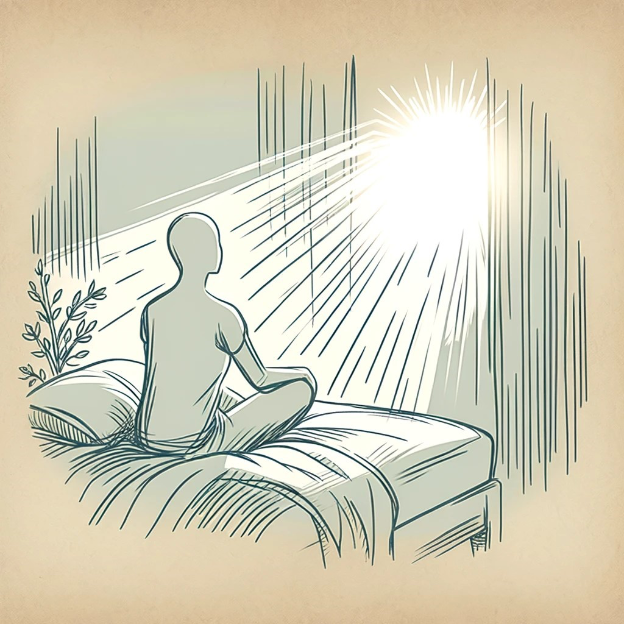
The Two Minutes Nobody Takes
Most of us begin our days in the middle of something. The alarm goes, and before we have fully arrived in the morning, we are already reading, scrolling, responding — already inside someone else’s agenda. The day does not begin so much as ambush us. And somewhere around mid-morning, or mid-afternoon, or on the drive home, we surface for a moment and wonder how we got here.
It is a strange way to spend a life. And yet most of us do it, most days, without question.

There is a difference between a day that happens to you and a day you meet with some intention. This is not a motivational claim — it is something quieter and more practical than that. Intention, in this sense, does not mean a to-do list or a productivity strategy. It means pausing, for just a moment, to ask: what do I actually want to bring to this?
That question sounds simple. It is surprisingly hard to remember to ask it.
The reason is partly structural. The modern morning is engineered for immediacy — notifications, news, the gravitational pull of other people’s needs. But it is also neurological. The brain at rest defaults to a kind of wandering. It rehearses worries, replays conversations, drifts toward the familiar and the unresolved. Left to its own devices, it does not naturally orient toward what matters today. It orients toward what is unfinished, uncertain, or loud.

This is not a flaw. It is how we are built. But it does mean that the day’s first conscious act carries more weight than we tend to give it.
Think about the mornings that have felt most grounded — the ones where you arrived at something rather than were swept into it. Often there was something small at the start: a moment of stillness, a clear sense of what the day was for, a choice made before the noise began. That quality of groundedness rarely happens by accident. It tends to be the result of something deliberate, however brief.
There is also something worth noticing about the act of naming what matters. When we articulate an intention — even silently, even privately — we are doing something different from simply hoping the day goes well. We are making a small claim on it. We are saying, in effect: I am here, and I have something to bring.

Research supports what many people sense intuitively. Psychologist Peter Gollwitzer at New York University has spent decades studying what he calls implementation intentions — the specific mental act of deciding in advance how you will approach a goal. His research consistently finds that people who form a clear intention about how they will act, not just what they want, follow through at significantly higher rates than those who hold a general aim. The difference is not willpower or discipline. It is specificity — the small act of naming something before the moment arrives.
Separately, a 2010 study by Matthew Killingsworth and Daniel Gilbert, published in Science, found that the human mind spends roughly 47 per cent of waking hours not focused on what it is actually doing — and that this mind-wandering consistently correlates with lower reported wellbeing, regardless of the activity itself. The implication is not that we should be relentlessly focused. It is that we have more agency over where our attention goes than we typically exercise — and that exercising it, even briefly, appears to matter.

My Fyrst draws from a tradition that understands emotion not as noise to be managed, but as information worth paying attention to. In that spirit, the intention you bring to a morning is not just a practical tool — it is a small act of self-knowledge. What you choose to name, and how it feels to name it, can tell you something about where you are right now.
The Navarasa framework, which sits at the heart of My Fyrst, recognises nine essential emotions as distinct human experiences, each with its own quality and signal. A morning intention might arrive with the quiet steadiness of Vīra — a sense of being ready, capable, oriented. Or it might surface something more like Śānta, a stillness that asks for gentleness rather than drive. What arrives is worth noticing. It is rarely random.

The mornings that feel most like ours tend to be the ones where we showed up to them — however briefly, however imperfectly — before the world had a chance to set the terms.
That does not require a ritual or a routine or an early alarm. It requires about two minutes and a willingness to ask one honest question before the day gets going.
What do you want to bring to today? Not what is expected of you, not what is already waiting — but what you, specifically, want to carry into the next several hours.
It is worth finding out.

My Fyrst is a personal practice, not therapy or clinical support. If you are going through a difficult time, please speak with a qualified mental health professional.