
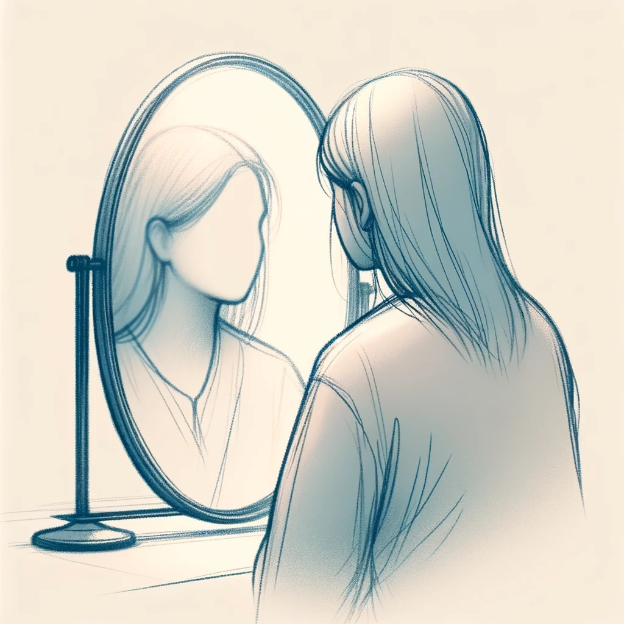
The Face You Forget to See
Most of us have stood at a mirror and looked without really seeing. We check — hair, teeth, the tiredness under our eyes — and we move on. The mirror becomes a tool for fixing, not for noticing. And somewhere in that habit, the person looking back gets a little lost.
It is not vanity that keeps us from truly looking at ourselves. It is something closer to discomfort. We have learned, most of us, to assess rather than observe. To find the flaw before someone else does. To get in and get out before the critical voice has time to warm up.

What We Actually See
When we look in a mirror, we are not seeing ourselves neutrally. We are seeing ourselves through every opinion we have ever formed — about how we should look, how we used to look, how we compare to some version of ourselves we carry in our heads. That version is often years out of date. And it is almost never kind.
This is not a small thing. The relationship we have with our own reflection is, in many ways, a rehearsal for the relationship we have with ourselves. If we cannot look at our own face with any softness, it is worth asking what that habit costs us over time — not just in front of the mirror, but in how we move through the day.

The Everyday Weight of Self-Criticism
Self-criticism is so ordinary that most of us do not notice how constant it is. It runs quietly in the background — a low hum of not quite enough, not quite right, not quite there yet. We mistake it for honesty. We tell ourselves that being hard on ourselves keeps us sharp, motivated, grounded.
The research suggests otherwise. Dr. Kristin Neff, a psychologist at the University of Texas at Austin whose work on self-compassion is among the most cited in the field, has found that self-criticism is consistently associated with higher anxiety, lower motivation, and greater fear of failure — while self-compassion is linked to emotional resilience, the ability to learn from mistakes, and a more stable sense of self-worth. Her work, available at self-compassion.org, draws a clear distinction between holding ourselves accountable and punishing ourselves — and finds that the latter rarely produces the outcomes we hope it will.

Looking Without Fixing
There is a particular quality of attention that changes things — not the attention of assessment, but the attention of simple, open observation. Noticing without immediately evaluating. Seeing without immediately deciding what to do about what you see.
Dr. Tara Well, an associate professor of psychology at Barnard College, Columbia University, has spent years researching what she calls mirror meditation — the practice of sustained, gentle self-observation. In her 2019 TEDx talk, What Mirror Meditation Can Teach You, she explains how looking at ourselves with open, non-judgmental attention can shift self-criticism toward self-compassion, help regulate emotions, and deepen our ability to stay emotionally connected to ourselves. The talk is worth twenty minutes of anyone’s time: ted.com/talks/tara_well_what_mirror_meditation_can_teach_you TED
This idea — that how we pay attention matters as much as what we pay attention to — runs through a great deal of contemporary psychology. We are not passive receivers of our own reflection. We are actively constructing what we see, moment by moment, shaped by habit and history.

A Different Kind of Familiarity
Ancient Indian philosophy understood human experience as richly emotional — not something to be managed or minimised, but something to be known. My Fyrst draws from a framework of nine essential emotions rooted in that tradition, each one treated as a signal worth understanding rather than a problem to be solved. What looking at yourself honestly might surface is different for everyone. For some it is Karuṇā — a tenderness, a compassion for the person looking back. For others it might be something harder to name. The invitation is simply to notice what is actually there, without deciding in advance what it should be.

What Happens When We Simply Look
There is something quietly radical about giving yourself one uninterrupted minute of honest, non-judgmental attention. Not to improve. Not to perform. Just to see.
We live in a world that is extraordinarily good at telling us what we should look like, feel like, be like. The mirror, for most people, has become one more place where that pressure lands. Reclaiming it — even briefly, even imperfectly — as a space for honest observation rather than assessment is a small act that carries more weight than it might appear to.
The next time you catch yourself at a mirror, moving quickly past your own reflection, notice that impulse. You do not have to slow down every time. But once in a while, it is worth asking what you might see if you stayed just a little longer — and looked with a little more kindness than you usually allow yourself.

My Fyrst is a personal practice, not therapy or clinical support. If you are going through a difficult time, please speak with a qualified mental health professional.