
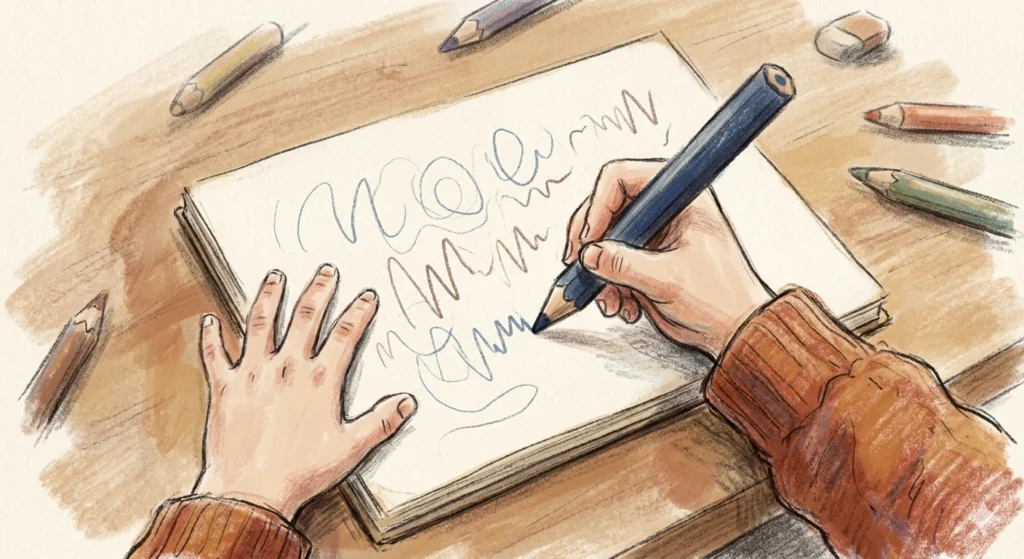
What Writing with Your Non-Dominant Hand Reveals
You already know how to write. You have known for decades. Your dominant hand moves across a page without any instruction from you — the letters form, the words appear, and your mind is somewhere else entirely before the sentence is finished. Writing, for most of us, stopped requiring our attention a very long time ago.
Which is exactly why it stopped telling us very much.
There is a particular kind of learning that only happens when we are not good at something. Not the grinding discomfort of genuine struggle, but the gentler disruption of doing something familiar in an unfamiliar way. The moment competence is removed — even temporarily, even artificially — something else arrives in its place. Attention. Actual, present, unhurried attention.
When you pick up a pen with the hand you never use, you cannot rush. You cannot be elsewhere. The simple act of forming a letter becomes an event that requires all of you — and in that small, slightly ridiculous moment, you are more present than you have been all morning.
This is not a new idea, even if it sounds like one. The concept of approaching experience without the filter of expertise or habit has deep roots — in Zen philosophy, it is called shoshin, or beginner’s mind. “In the beginner’s mind there are many possibilities,” wrote Shunryu Suzuki in Zen Mind, Beginner’s Mind (1970), “but in the expert’s mind there are few.” The insight is simple and a little uncomfortable: the more fluent we become at something, the less we actually see it.
Psychologist Ellen Langer at Harvard University has spent decades researching what happens when people interrupt automatic behaviour — doing things in slightly different ways, noticing small distinctions, approaching the familiar as if for the first time. Her research consistently finds that this kind of active noticing increases engagement, improves mood, and creates a quality of presence that routine simply cannot. The mechanism is not complicated. Novelty demands attention. And attention, it turns out, is where awareness lives.
What makes the non-dominant hand?
What makes the non-dominant hand particularly interesting is not just the novelty — it is the loss of control. Most of us spend considerable energy projecting competence: at work, in conversation, in the ordinary performances of daily life. We are practised at looking like we know what we are doing. Picking up a pen with the wrong hand strips that away in about three seconds. The letters wobble. The line drifts. The sentence that would normally take four seconds takes forty.
And something in that — something in the surrender of it — can feel unexpectedly freeing.
Researchers studying expressive writing have long noted that the way we write can influence what we access emotionally. James Pennebaker, whose foundational work at the University of Texas established the psychological benefits of expressive writing, observed that writing which requires genuine engagement — rather than mechanical production — tends to surface more honest material. When we slow down enough to actually feel the act of writing, we sometimes find that what arrives on the page is more truthful than what we planned to say.
My Fyrst draws on the understanding that emotions are not problems to be managed — they are signals worth noticing. And signals are easy to miss when we are moving too fast, too fluently, too automatically through our days. The nine emotions at the heart of the programme — rooted in the ancient Indian Navarasa framework — include Adbhuta: wonder, curiosity, the particular quality of attention that arrives when something surprises us. It is worth asking whether we give ourselves enough opportunities to be surprised. Not by grand events, but by the small, ordinary, slightly wobbly moment of not knowing what our own hand is going to do next.
Automaticity is useful. It frees up cognitive space for things that genuinely need our attention. But it also means that whole hours, whole mornings, whole conversations can pass without us really being in them. We were there. We just were not quite present.
The next time you notice yourself moving through something on autopilot — writing, eating, walking a familiar route, having a conversation you have had before — it might be worth asking what you are missing. Not in a critical way. Just with a little curiosity.
Sometimes the most interesting thing you will notice all day arrives in the gap between what you meant to write and what your other hand actually managed to produce.
My Fyrst is a personal practice, not therapy or clinical support. If you are going through a difficult time, please speak with a qualified mental health professional.