
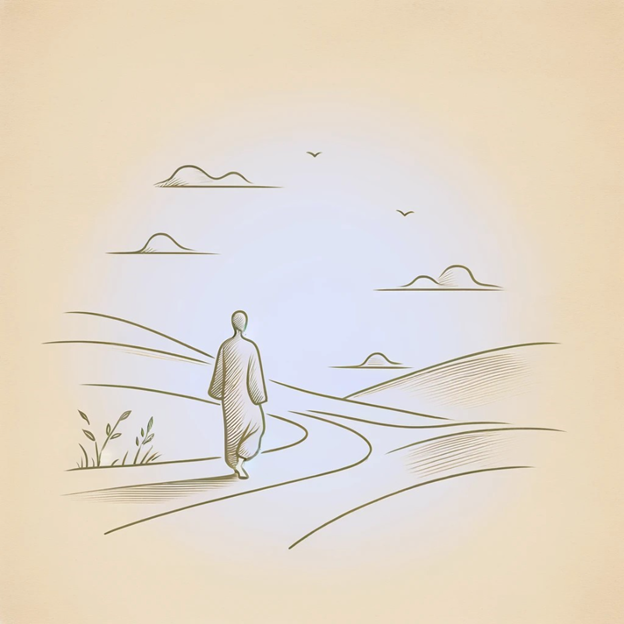
The Walk You Are Not Taking
There is a particular kind of busy that has nothing to do with what your body is doing. You can be standing in a queue, eating lunch, walking to your car — and be completely somewhere else. Replaying a conversation from this morning. Rehearsing one for later this afternoon. The body moves. The mind is elsewhere. And somehow, neither place gets your full attention.
Most of us do this dozens of times a day without noticing. It is not laziness or distraction in the way we usually mean it. It is just what an active mind does when it is not given anything specific to anchor to. It goes where it has unfinished business.
Walking is one of the most ordinary things a human being does. And yet, for most of us, it has become almost entirely invisible to our own experience. We walk to get somewhere. The getting there is the point. The walk itself — the feeling of it, the sounds and textures and shifting light — is simply the gap between where we are and where we need to be.
What changes when we close that gap? Not by walking faster, but by actually being present for the walk itself?
There is something quietly significant about choosing to pay attention to something you already do. It does not require learning a new skill or setting aside extra time. It asks only that you show up for what is already happening — the rhythm of your own footsteps, the weight of your body shifting from one foot to the other, the particular quality of the air on a Tuesday morning in whatever city or neighbourhood you happen to be in. These things are always there. We are simply rarely there with them.
The research on what happens when we walk with attention — rather than through it — is more compelling than you might expect. A 2022 study published in Frontiers in Public Health found that a single session of guided mindful walking produced a significant decrease in state anxiety and a measurable increase in present-moment awareness, even after just one session, in a diverse sample of university students. (PMC, 2024) A separate randomised controlled trial conducted at Charité Universitätsmedizin Berlin found that mindful walking reduced psychological distress in participants who reported high levels of stress — with effects that compared favourably to more structured mindfulness programmes. (PMC, 2013)
What both studies point toward is not that walking is a cure for anything. It is that bringing deliberate attention to movement — even briefly, even imperfectly — appears to shift something in how we feel. Research suggests the mechanism may have as much to do with sensory engagement as with the walking itself. When we attend to physical sensation — the ground beneath our feet, the rhythm of our breath, the sounds around us — we give the nervous system something concrete to orient around. The mental chatter does not disappear. But it loses some of its grip.
There is a quieter reason this matters that the research does not fully capture. When we pay attention to an ordinary thing, we are practising something. Not relaxation, exactly. Not mindfulness as a brand or a programme. Something more basic: the capacity to notice what is actually happening, rather than what we are thinking about what is happening.
That distinction — between experience and commentary on experience — is at the heart of emotional self-awareness. We spend a great deal of time in the commentary. Evaluating, planning, interpreting, judging. The commentary is useful. It is also relentless. And it can make it genuinely difficult to know what we are actually feeling in any given moment, because the feeling is buried under the analysis of the feeling.
Movement, it turns out, can be one of the simplest ways back. Not because walking is meditative in some elevated sense, but because the body is always, unavoidably, in the present moment. When we pay attention to it, we are pulled — briefly, gently — into the present with it.
My Fyrst draws from a tradition that understood human emotion as something to be noticed and named rather than managed or suppressed. In the ancient Indian framework of the Navarasa, nine essential emotional states were identified — not as problems to be solved, but as signals worth paying attention to. A walk taken with attention might surface any one of them: the quiet steadiness of Vīra, a kind of calm confidence in simply moving through the world; or Adbhuta — a small flash of wonder at something you have passed a hundred times but never quite seen before. What arrives will be different for everyone. The practice is simply in the noticing.
The next time you find yourself walking somewhere — to the kitchen, to the car, between meetings — try landing in it for just a moment. Feel the ground. Notice your breath. Take in whatever is around you without needing it to be remarkable.
You do not have to turn every walk into a ritual. You do not have to slow down dramatically or close your eyes or find a park. You just have to be, briefly, where your feet already are.
That small shift in attention — unremarkable as it seems — is where something worth noticing tends to begin.
My Fyrst is a personal practice, not therapy or clinical support. If you are going through a difficult time, please speak with a qualified mental health professional.